From the boom factory to the AI challenge: what does Vigevano teach us?
Abbiategrasso, August 21, 2026
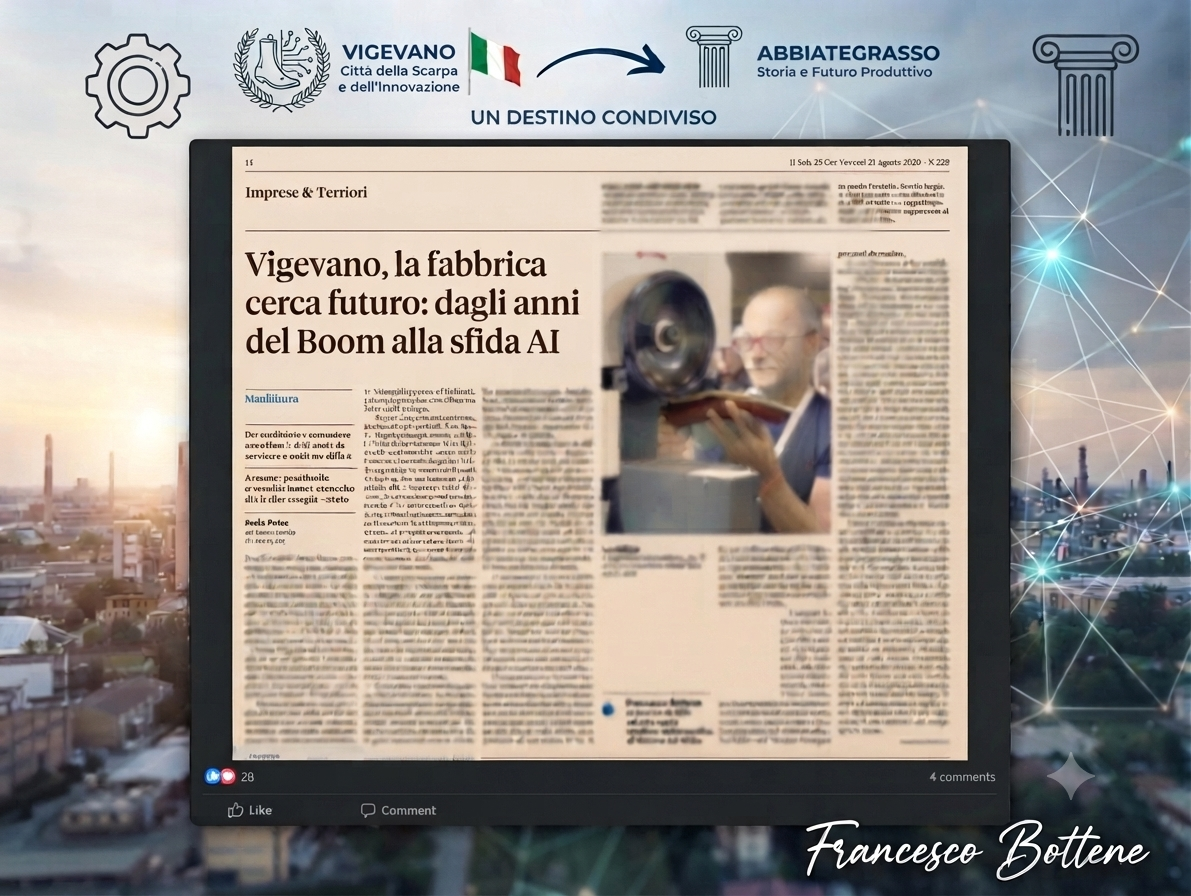
Reading today's Sole 24 Ore article, August 21, 2026, dedicated to Vigevano, I had a reflection that I believe is worth sharing.
Our 'next-door neighbor' offers us a mirror in which to look at our own reality, that of Abbiategrasso and the territories that have shaped Lombardy's productive history.
The investigation starts from afar: from the desks of vocational training schools and from the people who, with their inventiveness and the 'mirage of success,' transformed Vigevano from a poor land into a true engine of the economic boom, especially in footwear and related mechanical industry. But today that model shows signs of strain.
Key points that closely affect us
The axe of globalization
Collapse of the global market share of Italian footwear machinery, which fell from 30% to 10% due to Asian competition.
The obligatory leap towards high-tech
It is no longer enough to produce physical goods with the old low-tech mold. To stay on the market, it is necessary to evolve by focusing on automation, artificial intelligence, big data, and an integrated offering that includes technological support and customized design for the client.
The inestimable value of human capital
For me, a fundamental and often overlooked concept: future success is not based solely on machinery, but on the quality of training and technical skills of people, also historically drawing on excellent local vocational institutes.
The systemic brake
Italy and Europe continue to suffer from an excess of legal, bureaucratic, and infrastructural constraints that slow down competitiveness compared to other global markets.
The question that the journalist Paolo Bricco poses to Vigevano is the same one we must ask ourselves: how do we face the transition? The risk, for our territories, is to be crushed between the nostalgia for a glorious industrial past and the inability to invest structurally in innovation, training, and strategic vision.
The challenges change, but the need to have ruling classes, businesses, and communities open to change remains unchanged.