Almost one hundred and forty years of history: the monument to Giuseppe Garibaldi in Abbiategrasso
Abbiategrasso, 12 October 2026
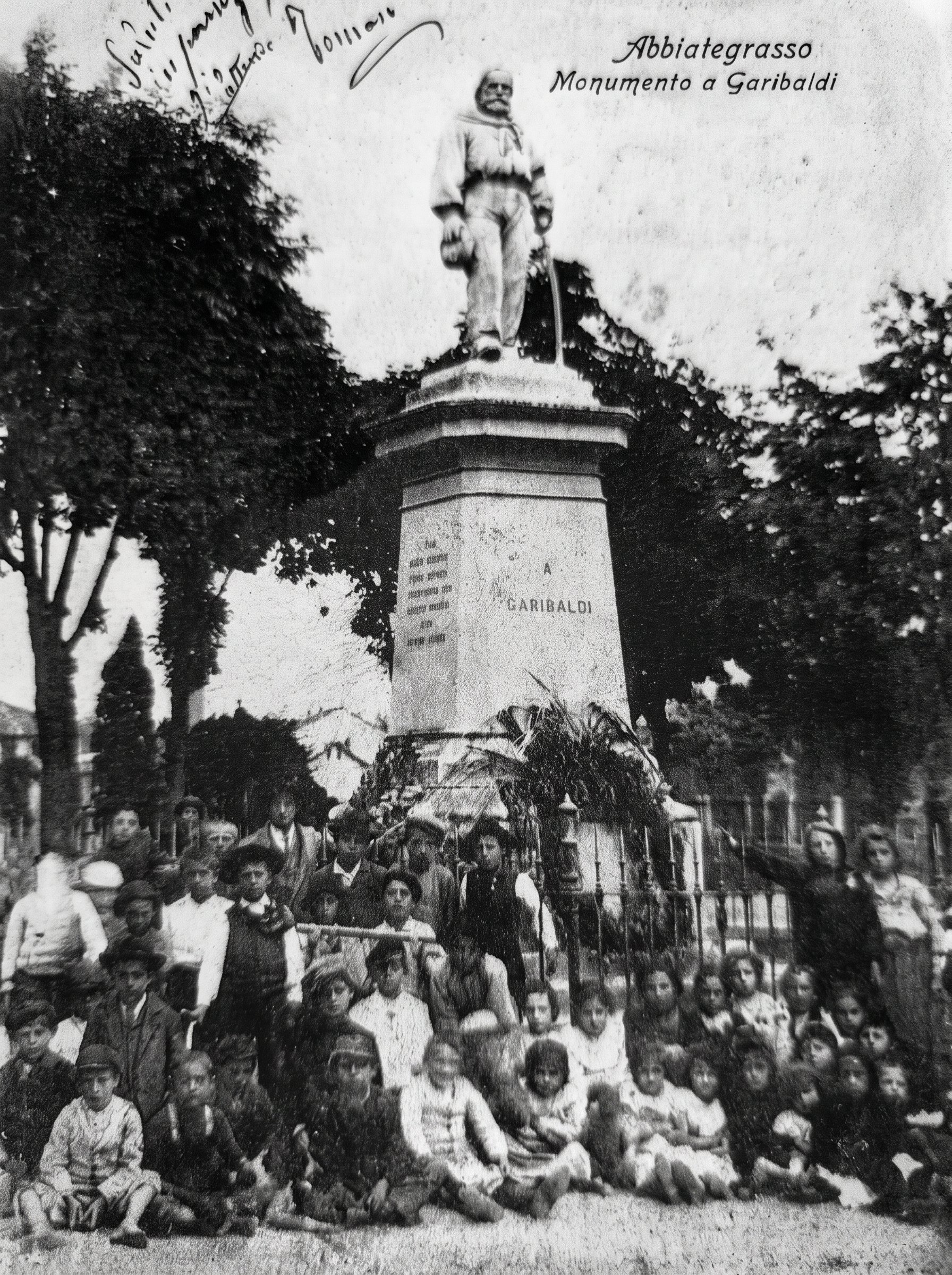
The story of the monument dedicated to Giuseppe Garibaldi in Abbiategrasso has its roots in 1881, when the «Società dei Reduci delle Patrie Battaglie» was founded with the aim of honouring the memory of those who took part in the events of the Risorgimento. The society's first initiative was the creation, in May 1882, of a Committee for the erection of a monument to the Fallen of the Patriotic Battles.
However, when news of Giuseppe Garibaldi's death arrived from Caprera on 2 June 1882, on 8 June the Committee unanimously resolved to turn the work into a statue dedicated to the Hero of the Two Worlds.
The first condolences and the fundraising
As early as 4 June the Municipality had sent a telegram of condolences to the mayor of La Maddalena, and 14 Town Councillors asked the Council to name a street or a main square after the deceased. The Società dei Reduci commissioned a commemorative plaque. Although the initial proposal was to place it in the cemetery, the idea of choosing a more prominent public location prevailed: the side of the castle overlooking the square to be dedicated to the General.
At the end of June 1882 a public subscription was opened and the Civic Administration promised a contribution. In August the Town Council delegated three members to represent it on the Committee, and in September resolved an allocation of 4,000 lire as a contribution towards the estimated cost of 7,100 lire.
In the meantime, contact resumed with the sculptor Bassano Danielli, who proposed executing the statue in Carrara marble. In March 1883 he presented a watercolour drawing and in April a plaster model, at a total cost of 7,000 lire. To raise the remaining 3,000 lire, dances and entertainment events were organised, which in October 1883 raised as much as 2,223 lire.
The disputes and the review committee
In February 1884 internal disagreements arose within the Committee. Some members criticised the decision to award the commission directly to Danielli without a public competition. Engineer Kluzer deplored the preference given to the project without considering alternatives. Accountant Sartirana (President of the Società Operaia) and other delegates defended the choice, recalling that the majority of the Town Council and the leadership had already made informal agreements with the artist.
To dispel any suspicion of partiality, it was decided to start over and hold an open selection until 10 June, exhibiting the projects to the public. To judge the proposals, a committee was appointed, composed of three renowned sculptors of the Brera Academy:
- Luigi Pagani
- Andrea Malfatti
- Francesco Barzaghi (already a collaborator on the statues of Milan Cathedral and author of the monuments to Manzoni and Napoleon III)
The three professors agreed in judging the original project by Bassano Danielli to be the best.
The construction and the inauguration
Once the commission was definitively awarded to Danielli (born in Crema, 1854 – Milan 1923, already a pupil of Barzaghi), the work was carried out at a total cost of 7,400 lire. The Municipality allocated a further 600 lire for the iron railing around the pedestal.
The monument was solemnly inaugurated on 29 May 1887, closing the initiative with a financial surplus of 149 lire.
The tribute to the fallen of Abbiategrasso
The work does not only celebrate Garibaldi: it also pays homage to the citizens of Abbiategrasso who shared his ideals. Engraved on the pedestal are indeed the names of the patriots from Abbiategrasso who fell on the battlefields for Italian independence:
- Bozzi Giuseppe (19 years old) – fell in 1848 in the Ledro valley
- Bonetti Michele (19 years old) – fell in 1848 in the Ledro valley
- Pizzochero Siro (26 years old) – fell in 1848 defending the Melghera fort in Venice
- Ponti Antonio (23 years old) – fell in 1848 near Mantua (fort of Pietole)
- Coccini Cesare (18 years old) – fell in 1859 in the battle of San Martino
- Silvestri Achille (19 years old) – died in Caserta in 1860 of wounds received at Capua
- Bardelli Attilio (21 years old) – fell in 1866 in the battle of Bezzecca
- Perini Domenico – died in Brescia in 1866 of wounds received at the battle of Custoza
- Rognoni Carlo (21 years old) – fell in 1866 in the battle of Bezzecca
Also remembered are those who later died of the wounds or illnesses contracted during the campaigns of liberation: Larini Angelo (1860), Pallavicini Francesco (1860), Agnesini Giovanni (1860), Rossetti Carlo (1861) and Vigevano Antonio (1865, decorated with the silver medal for military valour).
The source
The information in this article is taken from «Habiate», a quarterly magazine published by the Società Storica Abbiatense, issues 1985-1986.
Share